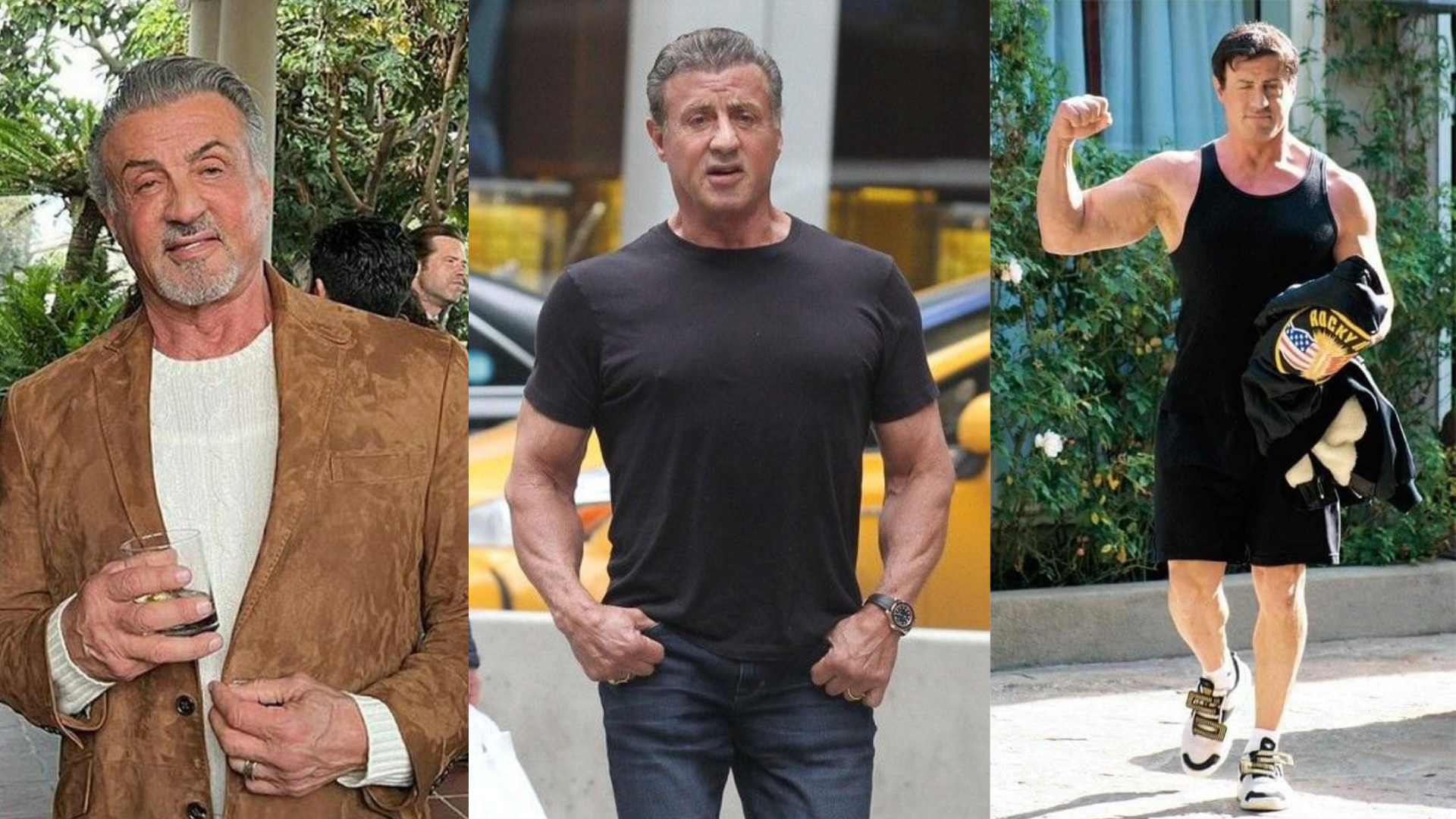
The Heart Behind the Muscles: Meet Sylvester Stallone
In a New York tenement, a baby was born with severe facial paralysis—half his face permanently frozen, his speech slurred and nearly unintelligible. Doctors said he would have permanent disabilities. Kids mocked his appearance relentlessly.
Nobody predicted this boy would become one of the most bankable, beloved action stars in cinema history. Nobody predicted he would create two of the most iconic characters ever filmed. Nobody predicted that his “handicap” would become his greatest asset.
His name was Sylvester Stallone. And his story is proof that the obstacles life gives you can become the fuel for your greatest achievements.
How a Kid with a Disabled Face Became Hollywood’s Most Powerful Action Star
The Brutal Beginning: Poverty, Disability, and Violence
July 6, 1946 – Michael Sylvester Gardenzio Stallone Jr. was born in Hell’s Kitchen, New York City, to Frank Stallone Sr., a beautician, and Jackie Stallone, a beautician and astrologer.
His first hours of life contained the seeds of suffering that would define him:
The Birth Injury:
During childbirth, the doctor used forceps improperly, severing the nerve that controls the left side of Stallone’s face. The result: Bell’s palsy—permanent partial paralysis of his face.
The Effects:
His left side of his face hung slightly limp
His speech became slurred and difficult to understand
Eating was complicated
His appearance was noticeably different from other children
He looked “broken” to a world that values physical perfection
The Family Dysfunction:
Beyond his disability, Stallone’s home life was chaotic:
His parents were constantly fighting
Violence between them was common
They divorced when he was young
He witnessed his father’s abuse toward his mother
He grew up in poverty in one of New York’s most dangerous neighborhoods
The Cruelty of Childhood:
With his facial paralysis and slurred speech, young Sylvester became a target:
Kids bullied him relentlessly
He was mocked for his appearance
Other children excluded him
He developed deep insecurity about his face
He felt fundamentally unlovable and broken
Most children with such obstacles would internalize the cruelty and believe the lies about themselves.
Stallone did the opposite. He got angry.
The Survival Strategy: Aggression and Toughness
Unable to be popular through charm or conventional attractiveness, Stallone chose a different path: He became tough.
The Compensation:
He learned to fight
He developed physical strength as a child
He became aggressive to deter bullies before they could mock him
He cultivated an aura of danger
He transformed his vulnerability into perceived strength
This wasn’t healthy psychology. It was survival psychology.
But it worked. By high school, people stopped mocking Stallone’s appearance because they were afraid of him.
The Athletic Pursuits: Finding Identity in Physicality
Unable to succeed academically or socially through conventional means, Stallone found outlet in physical pursuits:
Sports and Fitness:
Became obsessed with bodybuilding
Developed incredible muscular physique
Trained obsessively, finding in physical power what he couldn’t find in social acceptance
Used his body as armor against a world that rejected his face
Transformed his body into his identity and worth
The Realization: Stallone understood something crucial: In a world that rejected him for his disability, he could build a body so impressive that people would overlook his face.
This single insight would define his entire career.
The Invisible Years: From Laborer to Dreaming Actor
The Rough Years: Dead-End Jobs and Desperation (1960s)
After high school, Stallone faced the reality of his limited options:
The Work:
Worked as a nightclub bouncer
Worked as a cleaner at a gym
Worked as a dishwasher
Took any manual labor job available
Earned barely enough to survive
The Dream: Despite his limited education and obvious disadvantages, Stallone had a secret dream: He wanted to be an actor.
This wasn’t ambition based on evidence. He had no acting training, no connections, no obvious talent for performance. By every rational measure, it was a delusional dream.
But Stallone didn’t have the luxury of rational dreams. He had nothing to lose.
Acting Classes and Early Attempts (Late 1960s-Early 1970s)
Stallone took acting classes, desperate to understand the craft:
The Reality Check:
His slurred speech made dialogue difficult
His facial paralysis limited his range of expression
Teachers doubted his potential
Casting directors turned him away immediately
His disability seemed like a permanent obstacle to acting
But instead of giving up, Stallone made a crucial decision: He would use his disability as an asset, not hide it.
If his appearance was striking and memorable, he would lean into that. If his speech was unique, he would own it. If his physicality was his strength, he would build a career on physicality.
The Grind: Bit Parts and Survival (1970-1975)
Through the early 1970s, Stallone appeared in minor roles:
Small parts in forgettable films
Extra roles
B-movie appearances
Virtually no recognition or income
Constant rejection and disappointment
He was living in near poverty, doing bit parts, making barely enough to survive.
The Dark Years:
In desperation, he took a role in a pornographic film called “Party at Kitty and Stud’s” (1970), which he was deeply ashamed of
He was so desperate for money and work that he compromised his dignity
He earned only $200 for the role
Years later, the film would resurface to embarrass him
But even these desperate years were necessary. They were teaching him the business, building his understanding of cinema, and hardening his resolve.
The Breakthrough: From Desperation to Legend (1975-1976)
The Inspiration: A Muhammad Ali Fight (1975)
In 1975, Stallone attended a heavyweight boxing match between Muhammad Ali and a relatively unknown fighter named Chuck Wepner.
The Moment: Wepner, a journeyman fighter with no business being in the ring with Ali, fought with everything he had. He got knocked down but kept getting back up. He lasted the entire match, earning respect despite losing.
Stallone left the theater inspired. He didn’t care about boxing. He cared about the story: An underdog getting one chance to prove himself.
Writing “Rocky” (1975)
Stallone went home and sat down at a typewriter. He had barely finished high school. He had no writing experience. But he had a story burning inside him:
The Process:
He wrote frantically, pouring his own experience of being underestimated onto the page
He wrote about a small-time Philadelphia boxer named Rocky Balboa
He wrote about an underdog who gets a chance
He wrote about someone fighting not to win, but to prove he wasn’t just another “bum from the street”
He wrote with the intensity of someone writing to save his life
He finished the screenplay in three days.
The Impossible Gamble: Casting Himself
Stallone had written a role for himself. But he knew this was a massive gamble:
The Problem:
Nobody knew who he was
His speech impediment would be obvious on screen
His disability made him unconventional
Studios would want a star, not an unknown
The Desperation Move: Stallone pitched the screenplay to studios with one condition: He had to play Rocky.
Studios loved the script. They offered him money for it—substantial money. He could have sold the screenplay and never acted again.
But he refused.
Producers offered him more money: $300,000, $400,000, eventually over $500,000 for the script—an astronomical sum for someone living in poverty.
Stallone turned it all down.
His Reasoning: He knew if he sold the script, they would cast a famous actor—Robert Redford, Ryan O’Neal, or another established star. The film would be made, but it would be their story, not his.
He was willing to live in poverty forever rather than give up this one chance to tell his story.
“Rocky” (1976): The Impossible Dream Realized
Against all odds, against all logic, studios finally agreed: Stallone would play Rocky Balboa.
The Budget:
Filmed on a shoestring budget of $1 million
Used non-professional locations in Philadelphia
Shot quickly with minimal resources
Every constraint forced creative excellence
The Performance: Stallone brought everything to Rocky:
His own experience of being underestimated
His own journey from poverty to possibility
His own determination to prove himself
His physical presence and vulnerability
His speech impediment became Rocky’s authentic voice
The Release: “Rocky” premiered in November 1976 and became an unexpected phenomenon:
Grossed over $225 million worldwide (astronomical for a $1 million budget)
Nominated for 10 Academy Awards including Best Picture
Won Best Picture, Best Director, and Best Film Editing
Made Stallone an instant superstar
Created one of cinema’s most iconic characters
Proved that underdogs and outsiders could be heroes
The Significance: Stallone’s speech impediment and facial paralysis, which he had spent his life hiding and overcoming, became part of Rocky’s authenticity. The very disability he’d been ashamed of became integral to creating one of the greatest cinematic characters ever.
The Immediate Aftermath: From Rocky to Icon (1977-1982)
The Sequels: Building a Franchise
Rather than rest on his success, Stallone made bold creative choices:
“Rocky II” (1979):
Stallone directed and starred
Continued Rocky’s journey
Grossed over $200 million worldwide
Established Rocky as a franchise
“Rocky III” (1982):
Introduced Mr. T as the intimidating antagonist
Grossed over $270 million worldwide
Made Rocky a global phenomenon
The Strategy: Instead of doing random action films, Stallone deepened Rocky’s story. He understood that audiences didn’t just want action—they wanted meaning.
The Alternative Path: Creating Another Legend
While “Rocky” was making him a star, Stallone was working on another story:
“First Blood” (1982):
Created John Rambo, a Vietnam War veteran traumatized by war
Stallone brought vulnerability and pain to the action hero role
The film was a critical and commercial success
Introduced another iconic character
The Significance: Stallone proved he wasn’t just a one-hit wonder. He could create multiple iconic characters. He understood the psychology of underdogs and outsiders at a fundamental level.
The Golden Decade: Box Office Dominance (1982-1992)
The “Rambo” Franchise (1982-1988)
“First Blood” (1982) spawned sequels that became massive blockbusters:
“Rambo: First Blood Part II” (1985) – $300 million worldwide
“Rambo III” (1988) – $189 million worldwide
Each film explored different aspects of trauma, warfare, and redemption.
Continuing Rocky Evolution
While making Rambo films, Stallone continued the Rocky saga:
“Rocky III” (1982) – $270 million
“Rocky IV” (1985) – $300 million (Cold War epic)
Other Action Films
Stallone also diversified:
“Cobra” (1986) – Cop action thriller
“Cliffhanger” (1993) – Mountain action adventure
“Demolition Man” (1993) – Sci-fi action
The Pattern
Every major Stallone film grossed over $100 million worldwide. Many grossed over $200-300 million. He became one of the most bankable action stars in cinema history.
The Challenge: Aging and Reinvention (2000s-Present)
The Decline and Comeback
In the 1990s and early 2000s, Stallone faced what every action star faces: aging.
His roles began to dry up. Younger action stars (Van Damme, Schwarzenegger) were replacing him. Hollywood was moving away from 1980s-style action.
But Stallone refused to disappear.
“Rocky Balboa” (2006): The Resurrection
At age 60, Stallone wrote and directed “Rocky Balboa,” bringing the character back after 16 years.
Critics said it was career suicide. A 60-year-old man making a boxing movie? Nobody would watch it.
They were wrong.
The film grossed over $150 million worldwide and proved that audiences still loved Rocky. More importantly, it proved that Stallone still had creative fire.
“Creed” (2015) and Beyond
Stallone returned as a mentor figure in “Creed,” passing the torch to a new generation while remaining relevant:
Won critical acclaim
Earned an Academy Award nomination for Best Supporting Actor at age 70
Proved he could do dramatic work alongside action
Recent Resurgence
In his 70s, Stallone has:
Appeared in the “Expendables” franchise, celebrating action cinema
Done dramatic work in prestige television
Continued acting in quality projects
Remained an elder statesman of action cinema
The Secret Behind Stallone’s Unstoppable Rise
Lesson 1: Your Disability Can Become Your Asset
Stallone’s facial paralysis could have been a permanent obstacle. Instead, he made it part of his identity. Rocky’s unique voice isn’t despite the disability—it’s because of it. That authenticity resonated with millions.
The Insight: The things you hate about yourself often contain your greatest strength, if you’re brave enough to own them.
Lesson 2: Desperation Is Fuel
Stallone didn’t become successful because he had options. He became successful because he had no options. He couldn’t fall back on charm or conventional attractiveness. He had to create something authentic and powerful.
That desperation forced excellence.
Lesson 3: Own Your Story
Instead of hiding his background or pretending to be something he wasn’t, Stallone wrote Rocky as his alter ego. Rocky’s journey from nothing to something was Stallone’s journey. The authenticity was undeniable.
Lesson 4: Refuse the Easy Money
Stallone was offered substantial money to sell “Rocky” to other actors. He refused because he understood something crucial: This story was his to tell. Selling it would have made him wealthy but unfulfilled.
He chose fulfillment over security.
Lesson 5: Create Multiple Successes
Stallone didn’t rest after Rocky. He created Rambo. Then he did other films. He understood that one success isn’t enough—you must keep creating.
Lesson 6: Adapt Without Losing Your Core
As action cinema evolved, Stallone evolved. But he didn’t become someone else. He became a mentor, an elder statesman, a dramatic actor—all while remaining fundamentally Stallone.
The Financial Journey: From Poverty to Hundreds of Millions
The Numbers:
MetricBefore RockyAfter Rocky
Net Worth
~$0, living in poverty
$400+ million
Annual Income
Barely surviving
$20-50 million at peak
Career Prospects
Dead-end laborer
Hollywood icon
Opportunities
Virtually none
Unlimited choices
Recognition
Unknown
Global superstar
The Box Office Impact:
Rocky franchise: $1+ billion worldwide
Rambo franchise: $900+ million worldwide
Other films: $1.5+ billion
Total: Over $3.5 billion in box office from his films alone
Personal Life: Complex and Real
Marriages and Children
Stallone has been married three times:
First marriage to Sasha Czack produced his son Sage (who tragically died in 2012)
Second marriage to Brigitte Nielsen ended in divorce
Third marriage to Jennifer Flavin has lasted 25+ years
He has five children and remains an active, involved father despite his demanding career.
The Tragedy
The death of his son Sage in 2012 devastated Stallone. He’s spoken openly about the grief and how it affected him.
This tragedy reminded him—and audiences—that beneath the muscles and action heroics, Stallone is fundamentally human.
The Journey: Before & After
AspectThe Disabled Kid (1946-1975)The Action Legend (1976-Present)
Financial Status
Living in poverty
$400+ million net worth
Career
Dead-end labor jobs
Hollywood icon
Recognition
Nobody, mocked for disability
Global superstar
Opportunities
None visible
Unlimited options
Box Office Power
None
$3.5+ billion from films
Physical Appearance
Source of shame
Source of power
Self-Worth
Broken and worthless
Accomplished and valued
Influence
Minimal
Created iconic characters
Control
None over circumstances
Owner of his destiny
Legacy
Unknown
Legendary cinema icons
The Bottom Line: Why Stallone’s Story Matters
Sylvester Stallone is proof that your greatest obstacles can become your greatest assets.
Born with severe facial paralysis, bullied throughout childhood, forced into poverty and dead-end jobs, dismissed as an actor—Stallone had every reason to believe he was destined to fail.
But he made different choices: ✓ He owned his disability instead of hiding it ✓ He built physical strength when social acceptance was impossible ✓ He refused to sell his vision, even when desperate ✓ He created authentic stories from his own experience ✓ He chose meaningful work over easy money ✓ He refused to accept anyone else’s definition of his potential
The result: Two of cinema’s most iconic characters (Rocky and Rambo), over $3.5 billion in box office revenue, and a legacy that will endure for generations.
Key Takeaways for Outsiders and Dreamers
💪 Your disability or difference isn’t your weakness—it’s your distinction 💪 Desperation can fuel excellence if channeled properly 💪 Own your story instead of hiding it 💪 Turn pain into art, not bitterness 💪 Physical strength is both metaphor and tool 💪 Authenticity trumps perfection every time 💪 Create from your experience, not your imagination 💪 Refuse easy money if it means sacrificing meaning 💪 Keep creating, don’t rest on past success 💪 Adapt and evolve without losing your core identity
Stallone’s Defining Words
“The world ain’t all sunshine and rainbows. It’s a very mean and nasty place, and I don’t care how tough you are, it will beat you to your knees and keep you there permanently if you let it.” – Rocky Balboa (Stallone’s words)
“I’m always thinking about creating. My default is to create, not to take in.”
“It’s the ultimate inspiration—writing something that people can actually relate to.”
“The difference between the impossible and the possible lies in a person’s determination.”
The Continuing Legacy
In his late 70s, Stallone continues to work, create, and influence:
Appearing in quality films and television
Directing projects he believes in
Mentoring younger actors and filmmakers
Remaining active and engaged with his craft
Using his platform to inspire others who feel like outsiders
This is the real Stallone story:
Not just a man who overcame obstacles to become successful. But a man who transformed his deepest shame into his greatest strength.
He proved that in a world obsessed with conventional beauty and conventional success, there is power in being unconventional. Power in being damaged. Power in being real.
That’s why Rocky Balboa endures. That’s why Rambo endures. That’s why Sylvester Stallone endures.
Because his characters—and his life—are proof that the underdog can win. The outsider can belong. The broken can become whole.
And that possibility, that hope, is immortal.